
Every year, Microsoft Ignite gives us a glimpse of the future of work. This year, that future looked much less like a clever chatbot sitting on the side of your screen and much more like a digital workforce of AI agents, deeply embedded in the way organisations operate.
Across the keynotes and breakouts, one message came through clearly. The organisations that will pull ahead are the ones that treat AI agents as part of their operating model, not as side projects. Microsoft is calling these organisations Frontier Firms, and the ideas behind that label matter for every Australian board and executive team.
In this article, we unpack the key Ignite themes and what they mean in practice for leaders who want to move beyond experimentation and build an AI powered business.
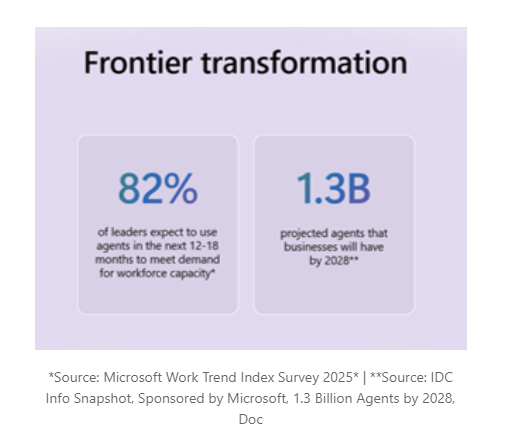
Source: Microsoft Work Trend Index Survey 2025 | Source: IDC Info Snapshot, Sponsored by Microsoft, 1.3 Billion Agents by 2028, Doc
1. The era of agents has arrived
Copilot was the headline act in previous years. In 2025, Ignite shifted the spotlight to agents. Microsoft defines agents as software entities that can perceive, reason and act on behalf of people and systems. That sounds abstract until you see what is being built.
The launch of Agent 365 is the clearest signal of this shift. Agent 365 is a control plane for AI agents that gives IT and security leaders a single place to register, govern and monitor agents across the organisation. It extends familiar capabilities like Microsoft Entra, Defender and Purview to AI agents, so you can see which agents are in use, who owns them, what data they can access and how they are performing.
Rather than AI projects growing up in the shadows, Agent 365 is designed to bring them into the light. That matters for three reasons:
You can scale what works instead of running disconnected pilots.
You can manage risk with the same discipline you apply to human access and identities.
You can finally measure adoption and ROI for AI in a structured way.
Alongside the platform, Microsoft is also rolling out specialised agents for sales, IT administration, workforce insights and more, integrated directly into Microsoft 365. The vision is simple. Agents should live where work already happens, not in a separate AI playground.
2. Microsoft 365 Copilot becomes the work operating layer
Copilot is not going away. It is evolving into an orchestration layer that coordinates people, content and agents across Microsoft 365. Ignite introduced new capabilities that make Copilot feel less like a point feature and more like part of the fabric of work.
Some of the highlights:
Agent experiences inside apps: Agents in Word, Excel and PowerPoint that can structure documents, analyse data and shape presentations through multi step, natural language interactions.
Richer context and memory: Copilot Chat can retain long running context and use it to build living artefacts like plans, reports and knowledge pages, not just one off answers.
Improved voice and mobility: Features like voice driven triage in Outlook support executives and frontline workers who live on the move.
The strategic takeaway is that Microsoft 365 is becoming the surface where human work and agentic work meet. For organisations, this raises important design questions. Where do you want human judgement to sit? Where can agents safely take on repetitive work? How will you measure the impact on productivity and employee experience?
3. Foundry and the rise of the AI platform engineer
Ignite also reinforced Microsoft’s direction with Azure AI Foundry (previously Azure AI Studio). Foundry is pitched as a unified platform for building and managing AI applications and agents, from model selection and orchestration, through to deployment and governance.
For technical leaders, the key signals were:
Foundry as the default hub to standardise how your organisation builds agents and copilots.
Support for a growing catalogue of frontier and specialised models, including third party providers, so you can choose the right model for each use case.
Tighter integration between Foundry, Microsoft 365 Copilot and the Azure AI Agents Service, which makes it easier to take an idea from experiment to production.
This is driving the emergence of a new role in many organisations. Call it the AI platform engineer or AI operations lead. Their job is to own the patterns, guardrails and tooling for AI solutions, so individual teams are not reinventing the wheel with each experiment.
4. Data, databases and infrastructure catch up with AI ambition
Underneath the agent story is a significant shift in data and infrastructure. Microsoft used Ignite to announce SQL Server 2025 general availability, describing it as an AI ready enterprise database with native vector search, semantic intelligence and deeper integration with analytics and AI workloads.
Alongside this, Azure DocumentDB is now generally available as a fully managed, MongoDB compatible NoSQL service based on the open source DocumentDB standard governed by the Linux Foundation. It is designed for hybrid and multicloud scenarios and includes vector and search capabilities tuned for AI workloads.
For data leaders, the direction is clear:
Your operational and analytical data platforms are being refactored to be AI aware by default.
You will be able to run consistent patterns across on premises, Azure and other clouds without being tied to one proprietary stack.
The barrier between transactional and analytical data is getting thinner, which opens up more near real time AI scenarios.
The organisations that benefit most will be those that take this as a cue to simplify and unify their data estate, rather than layering AI on top of a fragmented foundation.
5. Security, governance and the reality of autonomous workflows
With more autonomous agents comes more risk. Ignite therefore had a strong focus on security and governance.
Microsoft introduced a Baseline Security Mode that provides a guided path to turn on recommended protections across Microsoft 365 in a few clicks. At the same time, Microsoft Purview capabilities are being extended to cover AI specific risks, including data loss prevention for prompts and responses in Copilot, as well as observability into what agents are actually doing in production, regardless of which model is underneath.
Agent 365 also plays a central role here. By giving security and risk teams a single inventory of agents and their permissions, it reduces blind spots and makes it possible to apply consistent controls at scale.
The implication for leadership teams is that AI governance can no longer be treated as an add on. It needs to be designed into the way you adopt agents, integrate data, and train people.
6. Enter the Frontier Firm
Perhaps the most strategically important concept introduced at Ignite is the Frontier Firm. Microsoft describes Frontier Firms as next generation organisations that embed AI agents across many business functions and see materially higher ROI than their peers.
To support this, Microsoft is investing heavily in skilling programs such as the Agentic AI and Copilot Partner Skills Accelerator, as well as new workshops and learning paths focused on multi agent solutions and Copilot based transformation.
For partners like nexwave, there is a clear expectation. We are asked to become Customer Zero, applying agentic patterns inside our own organisations first, then helping customers follow a similar path with credible, lived experience.
For customers, the key questions are:
Where in your business could agents create real leverage in the next 12 to 24 months?
What data and platform investments are needed to support that vision?
How will you lift skills and confidence, so people trust and adopt these new ways of working?
What this means for Australian organisations
For Australian organisations, Ignite 2025 should not be viewed simply as a list of new features. It is a blueprint for how AI will be operationalised at scale.
The winners will be the organisations that:
Treat agents as part of their workforce design, with clear roles, controls and measures of success.
Invest in unified data and AI platforms rather than isolated experiments.
Build security and governance into their AI strategy from the start.
Commit to skilling leaders and teams so AI is embedded in how the business runs, not bolted on at the edge.
At nexwave, this is exactly where we are focusing our work with customers: defining agent strategies, building on Microsoft 365 Copilot and Foundry, modernising data platforms and designing responsible AI operating models that are practical, safe and business led.
If you are looking at these Ignite announcements and wondering what they mean for your organisation, now is the right time to map your path. The tools are here.
The question is how quickly you can turn them into a real advantage.
discover@nexwave.com.au